
832.402.6637Free Consultation
Updated & Reviewed by
Scott Armstrong -
July 9, 2026
After a car accident, you can be left wondering who was at fault.
In Texas, fault determines who is financially responsible for damages resulting from a crash, including medical expenses, lost wages, vehicle repairs, and pain and suffering. But determining fault in a car accident is not always straightforward. Multiple parties may share responsibility for an accident, and several entities, including police officers, insurance companies, and the courts, may all have a role in deciding who is liable.
Generally, fault is determined by examining the evidence surrounding the crash and identifying which driver’s actions were negligent. Negligence is a legal term that means someone failed to act with reasonable care under the circumstances.
For example, a driver who runs a red light, follows another vehicle too closely, or drives while distracted may be considered negligent if those actions directly caused a collision.
Texas also follows a modified comparative fault system. This means you may still recover compensation even if you were partially responsible for the accident. However, your compensation will be reduced by your percentage of fault, and if you are found to be more than 50% responsible, you cannot recover damages from another driver.
Understanding how fault is determined can help you protect your rights and avoid mistakes that could negatively impact your car accident injury claim.
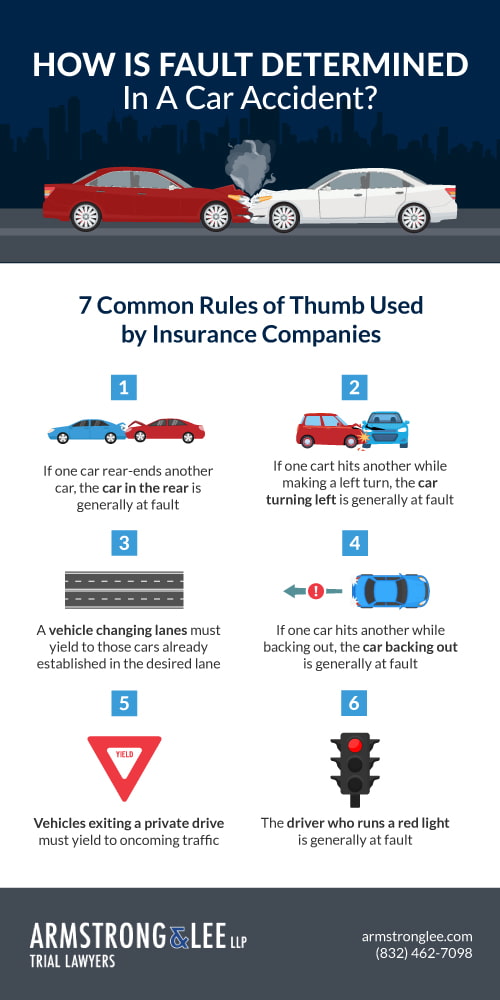
Fault is determined by gathering evidence, reviewing traffic laws, and evaluating the actions of everyone involved in the crash. Investigators are essentially trying to answer one question: Which driver’s actions caused the accident to happen?
In many cases, there is not a single piece of evidence that determines liability. Instead, multiple pieces of evidence are reviewed together to create a complete picture of what occurred before, during, and after the collision.
Some of the factors used to determine fault include:
Traffic law violations
Police reports
Witness statements
Photos and videos from the accident scene
Dashcam or surveillance footage
Vehicle damage patterns
Cell phone records
Expert accident reconstruction analysis
Some accidents are relatively straightforward. For example, a driver who rear-ends another vehicle is often presumed to be at fault because Texas car accident law requires drivers to maintain a safe following distance.
Other accidents can be much more complicated. If multiple drivers contributed to the collision, each person may be assigned a percentage of fault based on their actions.
Ultimately, determining fault comes down to establishing who acted negligently and how much each person’s actions contributed to causing the crash.
Texas follows a modified comparative fault rule, also known as proportionate responsibility. This system recognizes that more than one person can contribute to an accident.
Under Texas law, an injured person can still recover compensation if they are 50% or less responsible for causing the collision. However, their compensation will be reduced by their percentage of fault.
For example:
If your damages total $100,000 and you are found 10% at fault, you could recover $90,000.
If you are found 51% or more at fault, you cannot recover compensation from the other driver.
Insurance companies often attempt to shift a greater percentage of blame onto injured drivers because every percentage point assigned to you reduces the amount they may have to pay. This is one reason why gathering strong evidence early in the claims process is so important.
Evidence is one of the most important factors in any car accident claim. The stronger the evidence, the easier it becomes to establish who caused the collision and prove the extent of each person’s responsibility.
When police officers respond to a crash scene, they create an accident report documenting important details about the collision.
Police reports often include:
Driver statements
Witness statements
Road conditions
Vehicle positions
Diagrams of the accident scene
Citations that were issued
While police reports can be valuable evidence, they do not automatically determine liability.
Photos taken immediately after a collision can provide critical evidence. Drivers should photograph:
Vehicle damage
Skid marks
Debris in the roadway
Traffic signs and signals
Road conditions
Weather conditions
Visible injuries
Dashcam footage and nearby surveillance cameras can also provide an unbiased record of the collision.
Independent witnesses can help clarify disputed facts when drivers provide conflicting accounts of what happened. Witness testimony is often particularly valuable because witnesses typically have no financial stake in the outcome of the case.
The location and severity of vehicle damage can help investigators determine how an accident occurred. For example, significant front-end damage to one vehicle and rear-end damage to another may indicate that one driver was following too closely.
Many newer vehicles contain event data recorders that capture information such as vehicle speed, brake usage, steering inputs, and seat belt usage. Cell phone records may also be reviewed if distracted driving is suspected.
In complex collisions, attorneys may work with accident reconstruction specialists.
These experts analyze evidence and use scientific methods to determine how an accident likely occurred. Their findings can be especially helpful in disputed liability cases involving multiple vehicles or severe injuries.
When a car wreck is reported to the police, officers are sent out to the scene. As part of their job, the investigating officers prepare a police report about how the accident happened. The police officer will interview the drivers involved in the wreck, as well as any witnesses, to try and figure out what happened.
Once the police officer has gathered enough information to get a picture of how the accident happened, they will create a police report to record their findings. Although police reports often contain a written description of who was at fault for causing the collision, this is not always the case.
Sometimes, the officer cannot tell who was at fault for the car wreck and instead records each driver’s version of events.
As part of their investigation, the police officer who responded to the scene of the crash may write a ticket or citation accusing the at-fault driver of violating a traffic law. Citations can include failing to control speed, running a stop sign, making an improper left turn, or driving on the wrong side of the road.
Generally, the person who receives a traffic citation is considered to have been legally responsible and will probably be found to be at least partially responsible for the wreck.
However, the investigating officers do not always get it right.
Even if a police report finds that you were responsible for causing a car wreck, this does not automatically mean that you will be held liable for the other party’s injuries and property damage. Rather, in a civil case, a jury will make this decision at trial.
Once a claim is filed with an insurance company, the claim is assigned to an employee known as a claims adjuster. The claims adjuster is responsible for investigating who is at fault for causing the accident.
Because drivers in Texas are required to carry liability insurance, that means that there are usually multiple insurance companies investigating an accident.
For instance, if you are involved in a 3-car pile-up, there will usually be three claims adjusters looking into the collision to try and figure out who is responsible, with each driver’s insurance company assigning their own adjuster to look into the wreck.
Claims adjusters investigate the accident by talking to witnesses, reviewing medical records, looking at vehicle damage, and applying internal “rules of thumb” that insurance companies use to determine which driver is at fault.
It is important to understand that insurance companies all use these internal rules—but they do so in a way that tilts the facts and finding of responsibility in favor of their own customer (the policyholder).
That is why we recommend that you file a claim with your own insurance company—even if you believe the other driver was at fault.
It is also important to understand that the rules that insurance companies use are actually based on the legal definition of negligence in the state where the wreck occurred. A driver is negligent when he or she fails to take the precautions that a careful person would take under the same or similar circumstances.
So, if a wreck occurs in Texas, the adjusters will try to apply Texas law to determine who was negligent and therefore at-fault for causing the collision.
If you were a passenger in a car accident in Texas, this same approach applies, however, since they rarely contribute to an accident, they are able to pursue damages from both parties.
If you file a lawsuit after a car wreck to seek compensation for your injuries, a court will determine who was at fault for the accident by using the state’s legal definition of negligence. When establishing fault in Texas, it is important to keep in mind that Texas courts use a modified comparative fault standard, or “proportionate responsibility.”
What this means is that if you are found to be partially at fault for causing the accident, then the money you are entitled to for your damages—your property damage and bodily injuries—may be reduced by your percentage of fault.
For example, if you were stopped at a red light, but were stopped beyond the white line when struck by an oncoming vehicle, then the insurance company—and eventually the court—could determine that you were 20% at fault for the accident and therefore 20% at fault for your injuries. Therefore, if you were awarded $10,000 in damages, you would only be able to recover 80% of that amount, or $8,000.
Texas also follows the 51% bar rule. What this means is that if a driver is found to be more than 51% at fault for causing a wreck, then that driver is prohibited from collecting damages from the driver who is found to be 49% (or less) at fault.
If you were involved in a serious car wreck, it is important to hire an experienced attorney who can develop the necessary evidence to show that the at-fault driver is legally responsible for all of your damages.
Being found at fault doesn’t necessarily mean you will have to pay damages out of pocket. In many cases, your auto liability insurance policy will cover damages up to your policy limits.
However, being found at fault can still have consequences. If you were injured in the accident and shared responsibility for causing it, your compensation may be reduced based on your percentage of fault.
You may also experience:
Increased insurance premiums
Reduced settlement amounts
Difficulty recovering compensation if you are more than 50% responsible
Potential personal liability if damages exceed your insurance limits
It’s also important to remember that an initial determination of fault is not always final. If you believe an insurance company assigned you an unfair percentage of fault, an attorney may be able to gather additional evidence and challenge that determination.
If you’ve been involved in a serious car accident in Texas and believe that the insurance company is treating you unfairly, contact Armstrong Lee & Baker for a free consultation.
Our car accident attorneys have the skill and experience to navigate your injury claim, protect your rights, and ensure that the insurance companies are treating you fairly. We’ll help preserve and develop evidence, communicate with insurance companies on your behalf, and fight for the compensation you deserve after an accident.
Scott Armstrong is the Managing Partner and co-founder of Armstrong Lee & Baker LLP. Known for his strategic insight and relentless pursuit of justice, Scott personally guides the firm’s approach to complex cases, including catastrophic injuries, vehicle accidents, workplace injuries, and product liability. His leadership has created a culture where excellence, innovation, and dedication to client success are paramount, and his influence is evident in every case the firm handles, often resulting in hundreds of millions recovered for clients.




This page has been written, edited, and reviewed by a team of lawyers following our comprehensive editorial guidelines. Our lawyers have more than 20 years of legal experience as personal injury attorneys.
If you are seriously injured in a car accident, you will have to deal with your own insurance as well as the other driver’s insurance. Worrying about contact...
Posted by Scott Armstrong
A first-party insurance claim involves filing a claim directly with your own insurance company for damages or losses. This type of claim typically covers incidents affe...
Posted by Scott Armstrong
Oftentimes, the single most important document in a motor vehicle collision case is the crash report (otherwise known as police report or car accident police report). ...
Posted by Scott Armstrong
 Call
Call
 Message