
832.402.6637Free Consultation
Our 18-wheeler accident attorneys have extensive experience representing victims of 18-wheeler crashes and big rig collisions across Houston and throughout Texas. We understand the devastating toll these wrecks can take. From the moment you hire us, we act quickly to investigate the crash, preserve evidence, and build a strong case for the maximum compensation you deserve.
We represent you, not a corporation, not a trucking company, and not an insurance carrier protecting its bottom line. When 18-wheeler accidents happen, powerful companies immediately deploy teams of lawyers and adjusters to limit their exposure. Our role is to stand between you and those tactics. Every strategy we develop, every expert we hire, and every argument we make is focused on one thing: protecting your rights and securing the full compensation you deserve after an accident with an 18-wheeler.
We handle every detail of your 18-wheeler claim, from federal trucking rules to uncovering all liable parties, and we aggressively challenge insurance companies that try to minimize your recovery. Reach out today for a free consultation with a 18-wheeler accident lawyer who will fight for you.
A crash with an 18‑wheeler isn’t just “another accident.” It can affect your health, your work, your confidence behind the wheel, and your financial stability.
In the video below, one of our clients shares what happened when a truck driver failed to signal, made a wide turn, and struck her Toyota Corolla. After the crash, she struggled with anxiety behind the wheel and was forced to change jobs while trying to recover and regain a sense of normalcy.
What she describes isn’t just the accident itself, it’s the uncertainty that followed. Not knowing what would happen next. Feeling overwhelmed by insurance calls. Wondering how to move forward when everything suddenly felt harder.
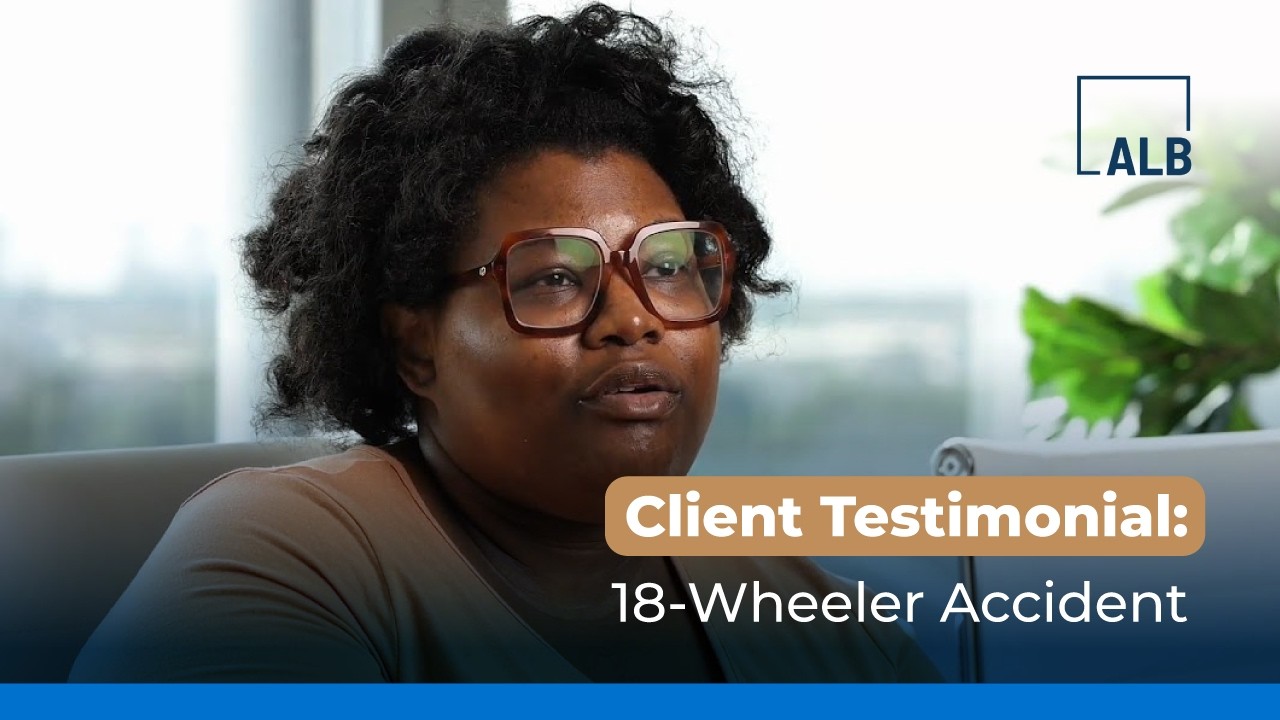
When she came to Armstrong Lee & Baker LLP, our first priority was to listen. We wanted to understand what she was dealing with, not just legally, but as a person trying to heal and make sense of what came next.
When we took her case, our priority was to reduce stress, protect the evidence, and keep her informed. That meant:
Throughout, our team stayed in regular contact so she wasn’t left guessing. She describes how that clarity and support helped her feel grounded again during an overwhelming time.
Truck cases can involve multiple responsible parties and layers of insurance. The difference between a strong claim and a weak one often comes down to early action, thorough documentation, and a team that’s prepared to push back when the other side tries to minimize your losses.
If you’re looking for a Houston 18‑wheeler accident lawyer who will treat you like a person, not a case number, her story shows the standard of care and communication we aim to deliver.
If you were injured in an 18‑wheeler or commercial truck accident, we’re here to help you understand your options and take the next step.
📞 Free Consultation — No Fees Unless We Win
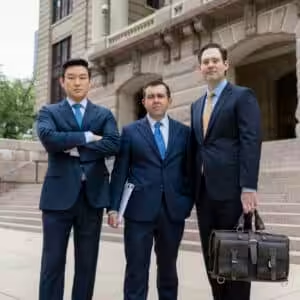
Our attorneys combine proven trial experience with client-focused care to hold negligent 18-wheeler drivers and corporations accountable.
 Armstrong Lee & Baker LLP has earned distinction from the Trucking Trial Lawyers Association (TTLA) as one of their Top 10 Trucking Trial Lawyers. This recognition reflects the firm’s proven expertise, relentless advocacy, and exceptional track record in handling complex trucking accident cases. It highlights our attorneys’ commitment to securing maximum compensation for clients and their standing among the nation’s most respected trucking law litigators.
Client Reviews
 Google Review
Mr. Scott Armstrong was incredibly supportive and kept me and my wife informed throughout the entire process of my car injury case, ensuring I understood every step and ultimately securing a fair settlement that significantly helped my recovery. His staff was awesome!!!! Very sweet ladies in the office. They made sure are travels were on point and we were comfortable.
Google Review If you’re thinking about hiring an injury lawyer, Armstrong Lee and Baker should be your first choice. I was in an accident in late March, and while my car didn’t suffer much damage, an MRI revealed I had two herniated discs in my neck and lower back. Thanks to ALB, after months of physical therapy and medical treatment, I received a settlement far larger than I ever expected. By the end of this year, I’ll be completely DEBT FREE!
A huge thank you to Eddie, my case manager, for his hard work in securing a great outcome, and to Wady, my lawyer, for his consistent communication and dedication to my case. This process does require you to stay committed to your appointments and do your part, but it’s absolutely worth it. Thank you, Armstrong Lee and Baker! <3
Google Review Joshua Lee and his team!!!
It was an amazing experience. After being in a sudden car accident, I was at a loss as to what to do and how to handle it first. However, after meeting Attorney Joshua Lee and his perfect team, I was able to smoothly handle the cumbersome and complicated tasks such as contacting and coordinating with the other party, receiving treatment, and repairing the car. As a result of negotiating with the best effort to represent the client’s interests until the end, I was able to receive sufficient and satisfactory compensation. What was particularly impressive was the professional and collaborative process. In addition to the irreplaceable and capable Attorney Joshua Lee, David and Adam kindly helped me at every important stage, Grace Lee who guided me through the difficult and stressful legal steps in detail, Soo-jin Han, the interpreter who provided perfect communication and comfort, Joy and Dennise who coordinated all the procedures and appointments… I am so touched and amazed that so many people, including many whose names I cannot remember, worked so hard for my case. I am very grateful to Armstrong Lee & Baker LLP for their excellent progress, amazing results, and the opportunity to learn more about legal solutions.
Google Review I couldn’t have asked for better representation. From day one, they took great care of me—not just as a client, but as a person. Throughout the entire injury case from my car accident, they kept me informed, made sure I felt supported, and handled every step with professionalism and confidence. At the end of the day, they got the job done. Grateful to have had them in my corner. Highly recommend.
Google Review I originally hired Jim antler and after a year of him stringing me along he declined my case said it wasn’t worth nothing. That’s when I called Adam at Armstrong Lee and Baker him and his associates took care of me like family got all the medical needs taken care of. Got me my next surgery Back on my feet and also got me awarded a check way bigger than what I was expecting. thank you Adam and your associates at Armstrong, Lee and Baker.
View More Reviews on Google Maps.
Accidents involving 18-wheelers are fundamentally different from standard car crashes. These cases often involve catastrophic injuries, multiple liable parties, and complex federal and Texas trucking regulations. Understanding these differences is critical to protecting your rights and recovering full compensation after a serious truck accident.
| Evidence Type | Lifespan Without Preservation |
|---|---|
| ECM / Black Box | Days to ~30 days |
| ELD Logs | ~6 months |
| Telematics / GPS | Varies |
| Dispatch Communications | Days to weeks |
| Physical Truck Condition | Hours to days |
$100,000 to several million, depending on injury severity and insurance coverage.
Trucks weigh up to 80,000 lbs vs 4,000 lbs for a car, causing severe injuries: traumatic brain injury, paralysis, amputations, fatalities.
Multiple parties may be responsible: trucking company, trailer owner, driver, maintenance or loading company.
FMCSA regulations govern driver hours, vehicle maintenance, training, and cargo. Violations are strong evidence of negligence.
Typically two years from the accident date, but early investigation is essential.
If you or a loved one is injured in an 18-wheeler accident, Armstrong Lee & Baker LLP will investigate and fight for full compensation. Contact us today for a free consultation. We are available 24/7 and you pay nothing unless we win.
C.J. Baker represents victims with serious injuries and he won’t let any corporation or insurance company stop his clients from getting complete justice. He has won millions of dollars for victims of 18-wheeler crashes, oilfield equipment failures, offshore platform explosions, and defective medical devices. Our lawyers have 25+ years of combined experience.



In Texas, the statute of limitations for personal injury claims following an 18-wheeler accident is generally two years from the date of the wreck. However, commercial trucking cases require immediate action to preserve evidence like black box data and driver logs before they are legally destroyed.
Liability in an 18-wheeler accident often extends beyond the driver. Depending on the cause of the crash, you may be able to sue the trucking company (carrier), the cargo loader, the maintenance contractor, or even the freight broker. We investigate FMCSA violations to identify all negligent parties.
Most 18-wheelers are equipped with an Event Data Recorder (EDR) or “Black Box.” This device records critical data such as speed, braking, and steering patterns leading up to a collision. Our Houston lawyers issue “Spoliation Letters” immediately to ensure this digital evidence isn’t wiped by the trucking company.
Yes. Texas follows a proportionate responsibility rule. As long as you are not more than 50% responsible for the accident, you can still recover damages. However, your total compensation will be reduced by your percentage of fault.
18-wheeler accidents typically involve much higher insurance policy limits (often $1M+) and more catastrophic injuries due to the 80,000-pound weight of the rigs. These cases also involve complex federal regulations that don’t apply to standard passenger vehicle accidents.







Trusted Personal Injury Attorneys in Houston
Find out if you have a case or ask us a question
by filling out the form below or call us at 832-402-6637
Armstrong, Lee & Baker did an absolutely wonderful job with my case. The resolution of my case was above and beyond what I expected! Shruti, the associate who handled my case showed great professionalism and I could not be more satisfied with the outcome. Thank you all!...

Josh Lee has been the best lawyer. He fights hard for you and will not give up until you are paid what you deserve. We were very fortunate to find him and his team. Any questions or concerns he was available day and night to answer anything we needed!
I had a great experience with this law office. The team communicated effectively and provided clear timelines for my accident case. Their professionalism and transparency made the process smooth. I highly recommend!! Emma Coomes and Dennise were amazing !

This page has been written, edited, and reviewed by a team of lawyers following our comprehensive editorial guidelines. Our lawyers have more than 20 years of legal experience as personal injury attorneys.
 Call Us: 832-402-6637
 Call
Call
 Message