
832.402.6637Free Consultation
When our clients come to us with a personal injury case, their questions almost always focus on legal terminology. Each personal injury case is walking a narrow line between multiple different laws that the average person has no reason to know.
At Armstrong, Lee, & Baker we pride ourselves on benign educators, just as much as we are a legal team. So, when our clients came to us with questions about strict liability, we knew we had an opportunity to help others out.
Strict liability is a fundamental legal principle that holds individuals or entities responsible for certain actions or damages without considering fault, intent, or the degree of care exercised. This principle is particularly relevant in personal injury law and is a crucial part of Texas legal statutes.
Worded simply? That means that if you were put in a dangerous situation resulting in injury, you may be able to recover damages without proving fault or negligence.
In this article, we’ll go more in-depth about:
A strict liability tort is a legal doctrine where a party can be held liable for damages regardless of their intent or negligence. Unlike other legal claims requiring fault proof, strict liability applies to inherently dangerous activities or conditions.
In strict liability cases, the defendant’s good faith, intent, or reasonable precautions are irrelevant. Even if the defendant took every precaution to prevent harm, they can still be held liable for damages. This strict standard of liability ensures that those engaging in inherently dangerous activities or dealing with potentially hazardous materials are held accountable for any harm caused.
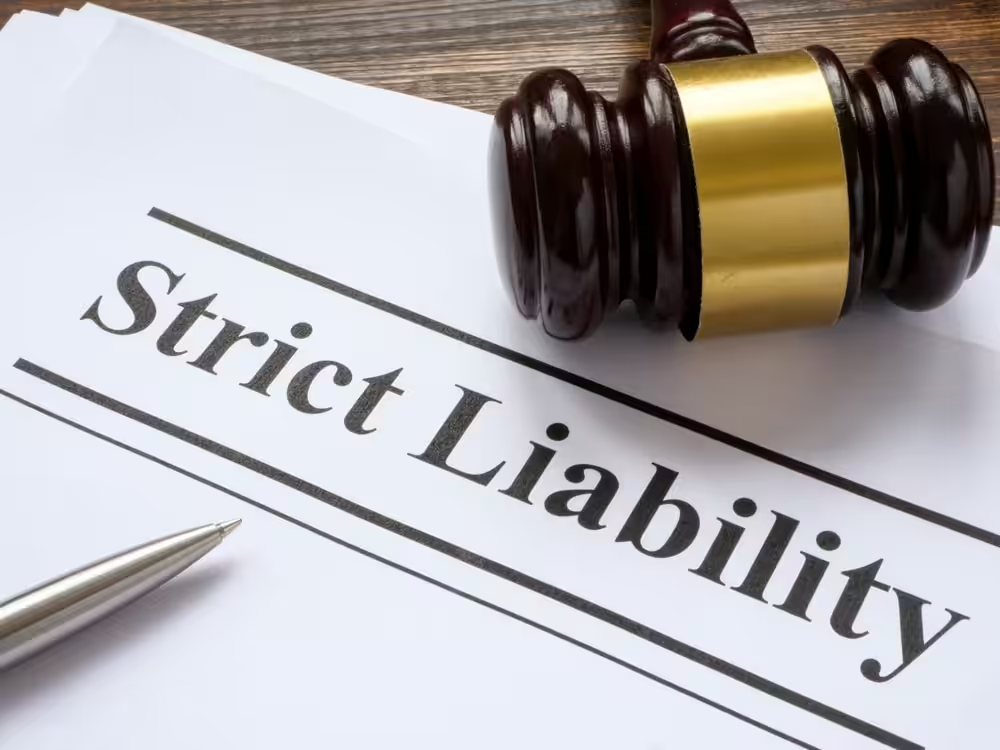
In personal injury, cases hinge on the level of liability of the defendant. Traditional personal injury cases typically rely on determining negligence.
What is negligence? In personal injury law, negligence is the failure to provide reasonable care. In order to win compensation in a personal injury case, you need to prove negligence on behalf of the defendant.
Strict liability, on the other hand, focuses on the consequences of the defendant’s actions rather than their intent or care. The plaintiff only needs to show that the action occurred and led to damages, making this a powerful legal tool in cases involving inherently dangerous situations.
Additionally, the scope of strict liability can extend to workplace injuries involving dangerous equipment or hazardous working conditions. In such scenarios, employers can be held strictly liable for accidents occurring under their supervision, regardless of safety measures taken.
Texas courts recognize specific scenarios where strict liability applies. These cases typically involve activities or products that carry an inherent risk of harm.
Manufacturers and sellers can be held strictly liable for injuries caused by defective products. There are three main categories of product defects:
Under Texas product liability law, strict liability protects consumers from foreseeable harm. Plaintiffs must prove that a defect caused their injury and that the product was unreasonably dangerous for its intended use. This protection ensures that manufacturers and sellers are incentivized to maintain high safety standards in both design and production.
Furthermore, strict liability for defective products applies not only to manufacturers but also to retailers and distributors who introduce defective products into the market. Companies are required to ensure quality control at every level of the supply chain to minimize risk.
Certain activities are so hazardous that those conducting them (or employing others to conduct them) can be held strictly liable for any resulting harm, regardless of the precautions taken. Examples include:
Even if the individual or company conducting these activities follows all safety protocols, they can still be held liable for any injuries or damages caused by their inherently dangerous nature. These activities are subject to strict liability because the potential consequences of accidents can be catastrophic, affecting not just individuals but entire communities.
Strict liability laws are designed to help protect you when serious injuries occur. Typically, clients who are able to file a personal injury lawsuit under strict liability are dealing with an extended healing process, inability to work, or other long-term repercussions.
Compensation is designed to make up for the losses you’ve suffered. Our clients often want us to quote them a general number they can expect to make back. Unfortunately, it is more complicated like that. Damages are, well….personal.
When putting together your case, we’ll review the following.
Clients that fall under strict liability are often suffering from severe injuries. Chemical burns, broken bones from failed harnesses and safety equipment, crush injuries, and even machinery entanglement can all happen on dangerous job sites.
We frequently see these kinds of injuries from clients who work in highly technical fields, such as on oil rigs. Severe injuries like these require immediate, and often long-term medical care. Naturally, the bills can pile up.
We take the time to compile all of your medical files and bills with you, and use those to factor into your final number.
Injuries can be costly. Not just in terms of paying for medical, but lost income can have a huge effect on your ability to earn your regular income.
If you’ve had to take time off of work to heal and pursue medical treatment, that’s money coming directly out of your pocket. We factor in that lost income when coming up with a number for your compensation.
Severe injuries don’t just affect your physical body. They can come with mental and emotional scars that need time and support.
Damages should take into consideration the mental toll that your injury has caused you.
When you’ve suffered severe injuries, you don’t deserve to have the mental weight of navigating the legal system on your shoulders as well. You need a team that’s competent, reliable, and can handle the ins and outs of strict liability cases.
At Armstrong, Lee & Baker, we’ve built a business out of being the strongest possible advocates for our clients. Our legal expertise leads to overwhelmingly positive results. With over 400 million dollars recovered for our clients, you can count on us to fight for justice, fair compensation, and recognition for what you’ve gone through.
Contact us today to set up your free, no-commitment consultation with our legal team.
Scott Armstrong is the Managing Partner and co-founder of Armstrong Lee & Baker LLP. Known for his strategic insight and relentless pursuit of justice, Scott personally guides the firm’s approach to complex cases, including catastrophic injuries, vehicle accidents, workplace injuries, and product liability. His leadership has created a culture where excellence, innovation, and dedication to client success are paramount, and his influence is evident in every case the firm handles, often resulting in hundreds of millions recovered for clients.



This page has been written, edited, and reviewed by a team of lawyers following our comprehensive editorial guidelines. Our lawyers have more than 20 years of legal experience as personal injury attorneys.
If you are seriously injured in a car accident, you will have to deal with your own insurance as well as the other driver’s insurance. Worrying about contact...
Posted by Scott Armstrong

If you have been injured in Texas, you do not have unlimited time to take legal action. The law sets strict deadlines for filing a personal injury lawsuit, typically...
Posted by Scott Armstrong
As a consumer, when you purchase or use a product, you expect that it will function properly and as designed. Unfortunately, however, this is not always the case. And ...
Posted by C.J. Baker
 Call
Call
 Message